Build one repeatable training system
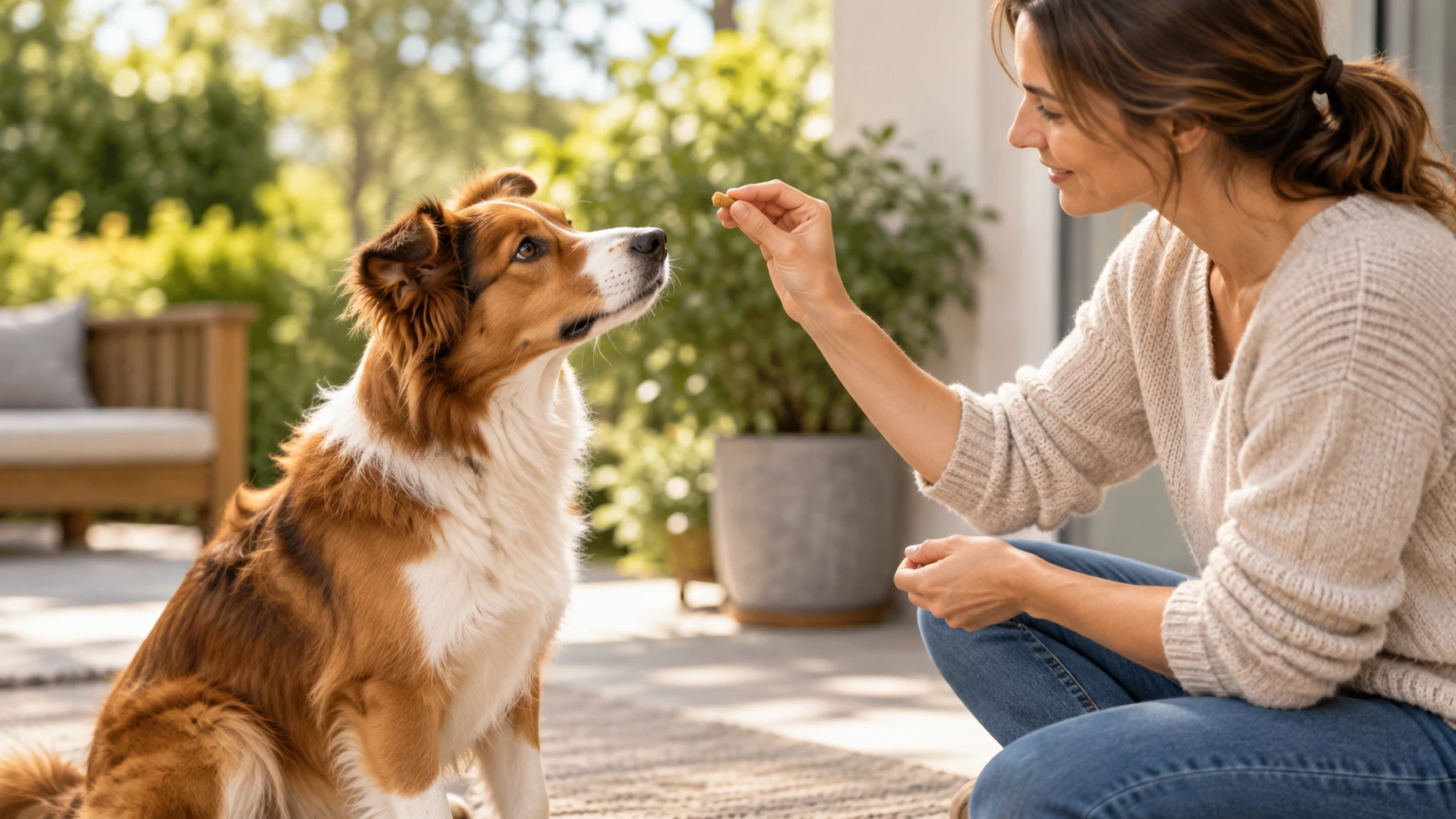
For ordinary skills, use reward-based training and arrange the environment so the behavior you want is easier to perform and worth repeating. The working loop is simple: behavior → marker → reward.
The behavior must be observable. “Four paws stay on the floor,” “nose touches my palm,” and “dog turns toward me when I say their name” are trainable criteria. “Behave,” “listen,” or “be good” are not precise enough to tell you what to reinforce.
A marker is a short, consistent signal such as “yes” or a click. It identifies the exact behavior that earned the reward. During marker training, the marker should predict a reward; it is not a replacement for one.
Set up the session before you ask for anything
Most beginner training improves when the setup is easier and the goal is smaller. Before the first repetition, decide four things:
- The behavior: what will the dog physically do?
- The starting setup: where can the dog solve this with few distractions?
- The reward: what does this dog want in this situation?
- The success criterion: what tells you the repetition was good enough to mark?
Start new learning in a familiar, low-distraction place. If the dog is scanning the room, trying to reach something else, or repeatedly leaving the session, change the setup before assuming the dog “knows” the behavior and is refusing to do it.
Choose a reward that competes with the environment
Food is convenient, but it is not the only possible reinforcer. Play, access to sniffing, moving forward on a walk, or social interaction can also reward behavior when the dog values them. Reward value is contextual: ordinary food may work in the kitchen and be irrelevant in a park full of smells.
Use rewards strategically rather than showing food before every cue. Food can help lure a new movement, but the long-term goal is for the cue or situation—not the visible treat—to tell the dog what to do.
Mark the moment, then deliver the reward
Mark while the correct behavior is happening. The reward can arrive a moment later because the marker has identified what earned it. Reward placement also matters. If you are teaching a dog to stay beside you, delivering food far in front can pull the dog out of the position you meant to reinforce.
Keep the marker consistent. If “yes” sometimes means “reward is coming” and sometimes means casual praise, it becomes less precise as a teaching tool.
Teach a new skill in seven steps
Capture a behavior the dog offers, lure a simple movement, use a target, or shape small approximations. Choose the method that makes the next correct response obvious without physically forcing the dog into position.
If you cannot get a correct repetition, reduce the criterion. A smaller, successful behavior gives you something to reinforce; repeating a cue for a behavior the dog cannot yet perform does not.
Step 2: Mark and reward the exact criterion
Mark as soon as the dog meets the criterion, then reward. Early repetitions should make the consequence easy to understand: the dog does the target behavior and something valuable follows.
Stay at this level until the behavior is appearing with little extra help. One accidental success is not evidence that the dog is ready for a cue or a harder environment.
Step 3: Build a predictable pattern before adding the cue
Repeat the same simple question while the dog is succeeding. You are looking for a pattern: the dog begins to offer the behavior promptly because the setup has become clear.
If performance gets slower across repetitions, stop and reassess. Fatigue, distraction, low reward value, or a criterion that became too difficult are more useful explanations to investigate than “stubbornness.”
Step 4: Add the cue when you can predict the behavior
Say the cue once just before the behavior is likely to happen. Mark and reward the response. Over repetitions, move the cue earlier until it reliably starts the behavior.
Do not repeat the cue several times in the same attempt. If the first cue does not work, change the setup or help the dog succeed rather than teaching that the word can be ignored until the third or fourth repetition.
Step 5: Fade prompts without confusing them with rewards
A lure or large hand motion helps produce a behavior; a reward reinforces the behavior after it happens. These are different jobs. Fade the visible prompt as soon as the dog can respond with less help, but continue reinforcing the learned behavior.
A dog no longer needing to see food first does not mean reinforcement should disappear. Familiar skills can move to more varied reinforcement, while harder environments usually justify increasing reward value or frequency again.
Step 6: Make the behavior useful in daily life
Practice the skill where you will actually need it, but treat each new environment as a partial reset. A behavior that is fluent in the kitchen may be much harder in the yard, near the front door, or on a walk.
Ask for an easier version in the new place, reinforce it well, and rebuild from there.
Step 7: Change one main difficulty at a time
Duration, distance, distraction, movement, and context can all change the difficulty of a behavior. Increase one while keeping the others easy. When the response becomes slower, less accurate, or less relaxed, return to the last level that was working.
Reliability is built by many successful repetitions across contexts, not by testing the dog with the hardest version as soon as the easy version works.
Worked example: teaching a hand target
Hold an open palm a few inches from the dog’s nose. Many dogs will investigate it. The instant the nose touches the palm, mark and reward. Repeat until the dog is deliberately moving to touch the hand.
Now present the hand from slightly different positions. When the touch is predictable, add a cue such as “touch” just before presenting the hand. Later, reduce any exaggerated arm movement and practice in another quiet room.
This small skill demonstrates the full system: define the behavior, create an easy setup, mark the right moment, reinforce, add the cue after the behavior exists, fade unnecessary help, then generalize gradually.
Diagnose the bottleneck instead of repeating the cue
| What you see | Most likely training problem | What to change next |
|---|
| The dog never offers the behavior | The starting version is too difficult | Split task smaller |
| The dog works only when food is visible | Food has become a prompt | Hide visible food |
| The cue works at home but not outside | The context jump is too large | Rebuild somewhere easier |
| Responses get slower during the session | The session is losing value | End session earlier |
| A familiar behavior is fading | Reinforcement became too sparse | Increase reinforcement again |
The table is a decision tool, not a set of universal diagnoses. If the dog suddenly stops doing a familiar behavior, seems painful, fearful, or physically uncomfortable, ordinary training troubleshooting is not the right first step.
What should a beginner train first?
There is no universal command that every dog must learn first. Start with the skill that solves the most important daily-life problem while you continue building the basic training loop above.
- If you need a safe way to call the dog back, start with recall training.
- If walks are difficult because the leash is usually tight, work on loose-leash walking.
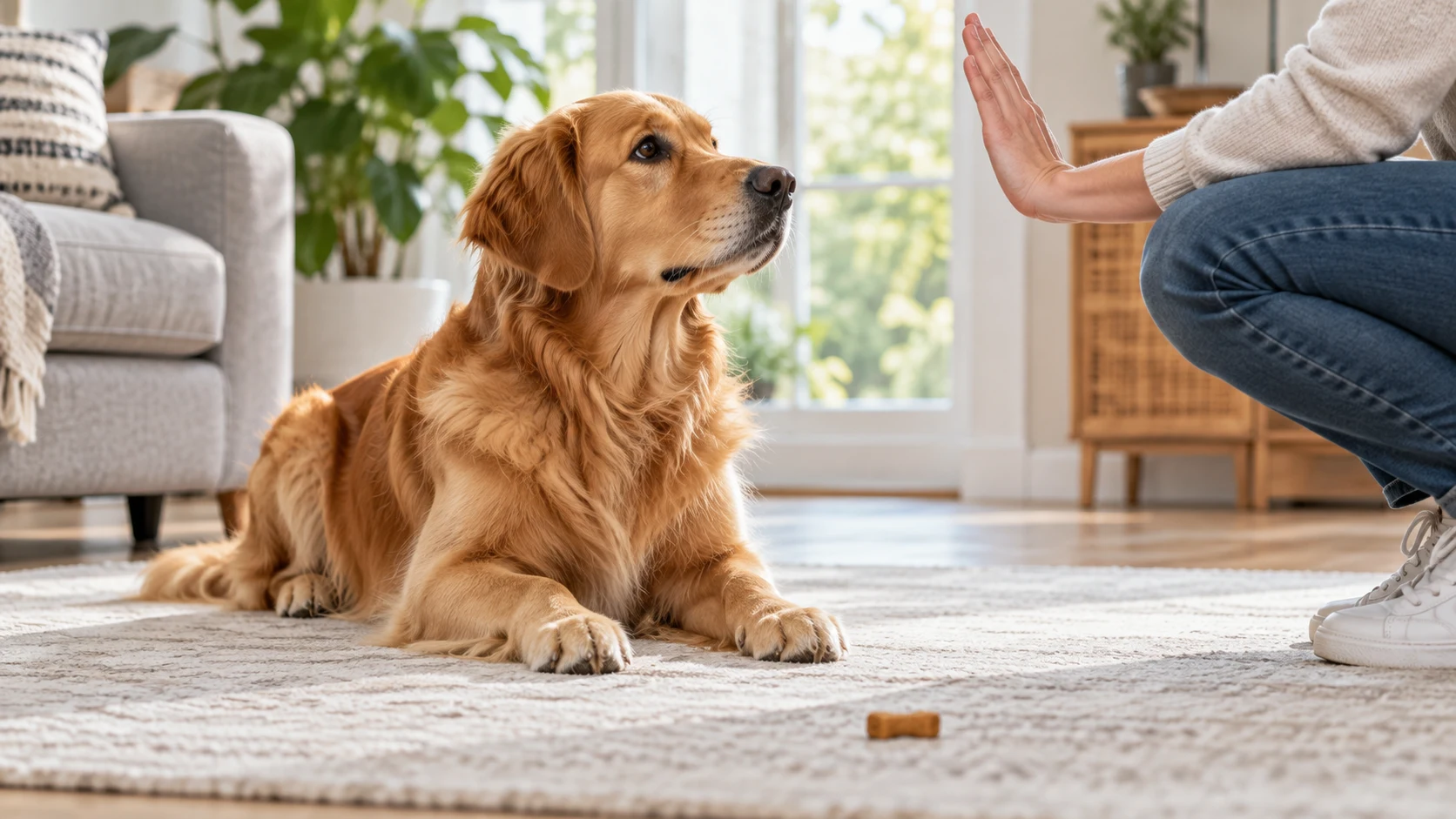
- For food, litter, or other objects the dog has not picked up yet, teach leave it.
- When an object is already in the dog’s mouth and needs to be released, teach drop it.
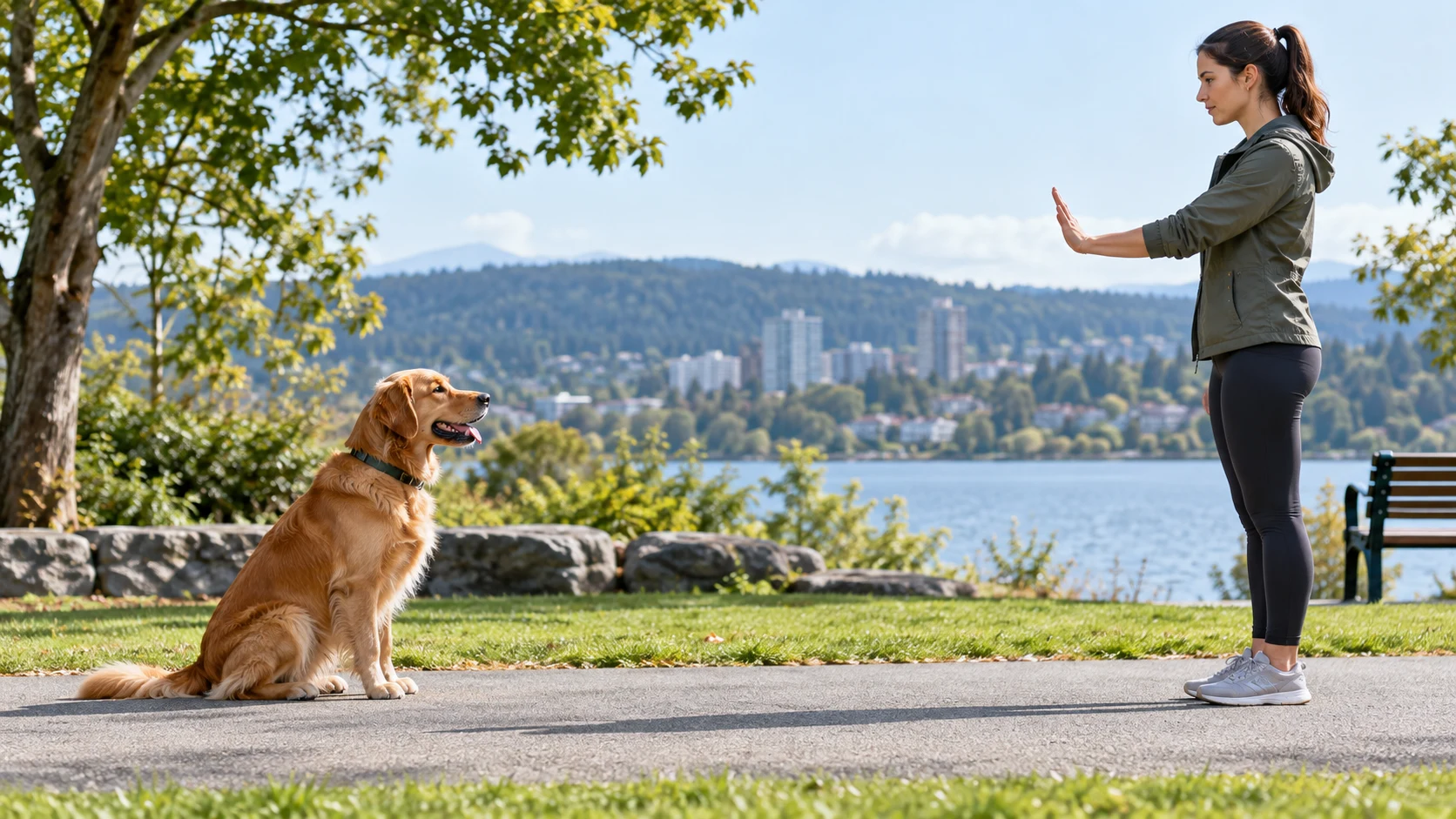
- If you need the dog to hold a position until release, build a clear stay.
- When quiet-room skills disappear around sights, smells, or movement, build focus around distractions.
Choose one priority, make it easy enough to succeed, and practice it in real situations gradually. A long command checklist is less useful than a few skills that work when you actually need them.
Management prevents rehearsal while training catches up
Training changes behavior through practice. Management changes the situation so unwanted behavior is less likely to occur while the skill is still developing.
A long line during recall practice, extra distance from a distraction, putting tempting objects out of reach, or choosing a quieter walking route can all be management. These measures are not failures and they do not replace training. They keep the dog and people safer while you create better repetitions.
When ordinary skill training is not enough
Fear, panic, aggression, severe guarding, sudden behavior change, or an inability to function in ordinary environments can require more than a generic training plan. Do not turn a safety or welfare problem into a harder obedience exercise.
Use qualified, reward-based professional help when the problem carries bite risk, significant distress, or repeated failure despite an appropriately easy setup. A veterinarian should assess sudden behavior changes or signs that pain or illness may be contributing.