Quick answer
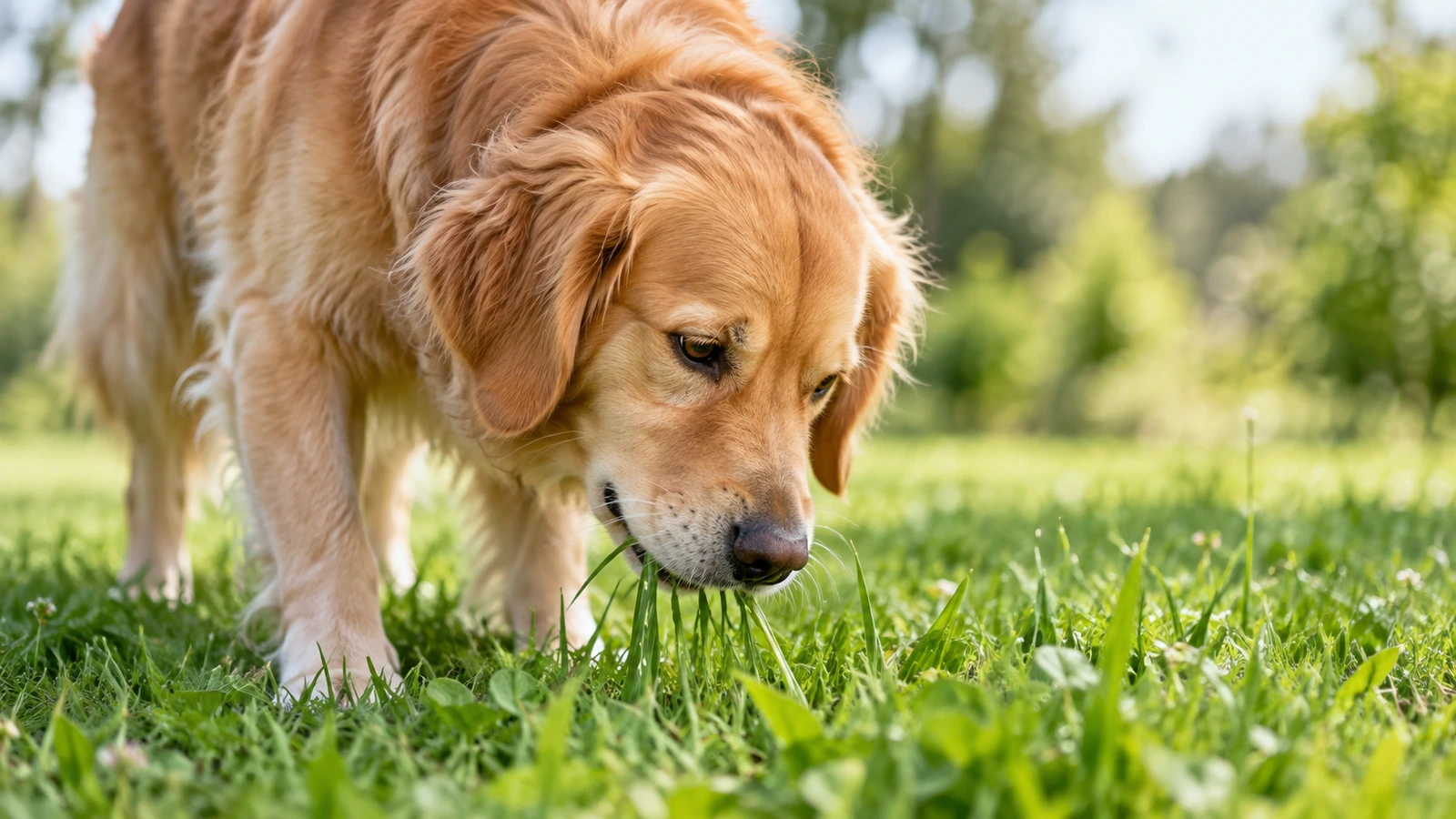
Dogs commonly eat grass, and science has not established one universal reason for the behavior. Available research does not support the popular idea that most dogs graze because they are ill or are deliberately trying to make themselves vomit. In a large owner survey of plant-eating dogs, only 9% were reported to frequently appear ill before eating plants and 22% frequently vomited afterward. For an otherwise well dog, occasional grazing can fit within normal behavior. The pattern matters more when grass eating is new or persistent, comes with repeated vomiting or other signs of illness, or involves treated lawns or unfamiliar plants.
What research says about how common grass eating is
The strongest broad study surveyed owners of healthy dogs and then a much larger group of owners whose dogs ate plants. Among 47 healthy dogs with daily access to plants, 79% had eaten grass or other plants. In the larger group of 1,571 plant-eating dogs, 68% were reported to eat plants daily or weekly, and grass was the plant eaten most often.
The study did not find a relationship between diet type and how often or what type of plants the dogs ate. The authors concluded that plant eating appears to be a normal behavior in domestic dogs.
Those results describe patterns, not a single cause. Much of the evidence came from owner reports, and the large survey specifically recruited people with plant-eating dogs. It can tell us that grazing is common and often occurs without obvious illness, but not why every individual dog does it.
Do dogs eat grass to make themselves vomit?
The evidence does not support that explanation as the usual reason. In the large owner survey, most dogs were not reported to look ill beforehand, and most did not frequently vomit afterward.
A later experiment tested the self-medication idea more directly. Dogs were observed while eating grass during periods with normal stools and during a diet phase that produced a mild diarrheal gastrointestinal disturbance. The dogs spent less time eating grass during the mild disturbance, not more. Across 374 grass-eating events, only two vomiting events occurred. The researchers concluded that the dogs in that experiment did not use grass as an emetic and did not appear to use it to self-medicate that type of gastrointestinal disturbance.
That finding has a limit: it tested one mild form of digestive disturbance. It does not prove that nausea or every other gastrointestinal problem can never influence grass eating in an individual dog.
Hunger and time of day may influence grazing
A small controlled study of 12 dogs found that they spent more time eating grass before their kibble meal than after it, and grass eating decreased later in the day. That suggests satiety and time of day can influence the behavior.
It is a useful clue rather than a universal explanation. The study was small, and dogs may eat grass in many contexts. If a dog mainly grazes before meals, the timing is worth noting, but it does not by itself show that the dog is underfed or has a nutritional problem.
Does eating grass mean a dog needs more fiber?
Grass eating alone is not evidence of a fiber deficiency. One published case report described a single Miniature Poodle with years of plant eating and vomiting that stopped after a switch to a high-fiber diet. That result shows that diet may matter in an individual case, but one dog cannot establish the general reason dogs eat grass.
The larger survey found no relationship between broad diet type and plant-eating frequency or plant choice. It also did not directly measure whether each dog was getting an optimal amount of fiber. The most accurate conclusion is therefore narrow: fiber can be relevant in some circumstances, but routine grass eating should not be treated as a diagnosis of dietary deficiency.
What science still does not explain
Many popular explanations remain possible but weakly established. Dogs may like the taste or texture, may graze as part of ordinary scavenging behavior, or may do it for reasons that differ from one dog to another. Boredom, anxiety, instinct and attention-seeking are also commonly proposed online, but current direct canine research does not establish any one of them as the general cause.
This is where evidence strength matters. The research supports that grass eating is common, that it often happens without obvious illness, that vomiting is not the usual outcome, and that hunger or time of day can influence it. It does not yet provide a single mechanism that explains every dog.
Is it safe to let a dog eat grass?
The grass itself is only part of the decision. Veterinary guidance warns that lawns can carry herbicides or pesticides, and grass in areas contaminated with feces can expose dogs to intestinal parasites. Avoid allowing a dog to graze where lawn chemicals may have been applied or where you cannot identify what plants are mixed into the area.
If your dog occasionally eats a small amount of familiar, untreated grass and remains well, the behavior alone is not strong evidence of a medical problem. If the environment is uncertain, redirecting the dog away from the grass is the safer choice.
When grass eating needs veterinary attention
Grass eating becomes a different question when it arrives with illness. Arrange veterinary advice if your dog has repeated or persistent vomiting, blood in the vomit, marked lethargy, abdominal pain, fever, or vomiting that continues for more than a day. A sudden change in grazing together with gastrointestinal discomfort also deserves more attention than an occasional, long-standing habit in an otherwise normal dog.
For a dog that keeps grazing, record when it happens, whether it clusters before meals, what the dog eats afterward, and whether vomiting or stool changes follow. That short pattern log is more useful than assuming the dog is “cleansing” its stomach or automatically adding fiber to the diet.