Quick answer
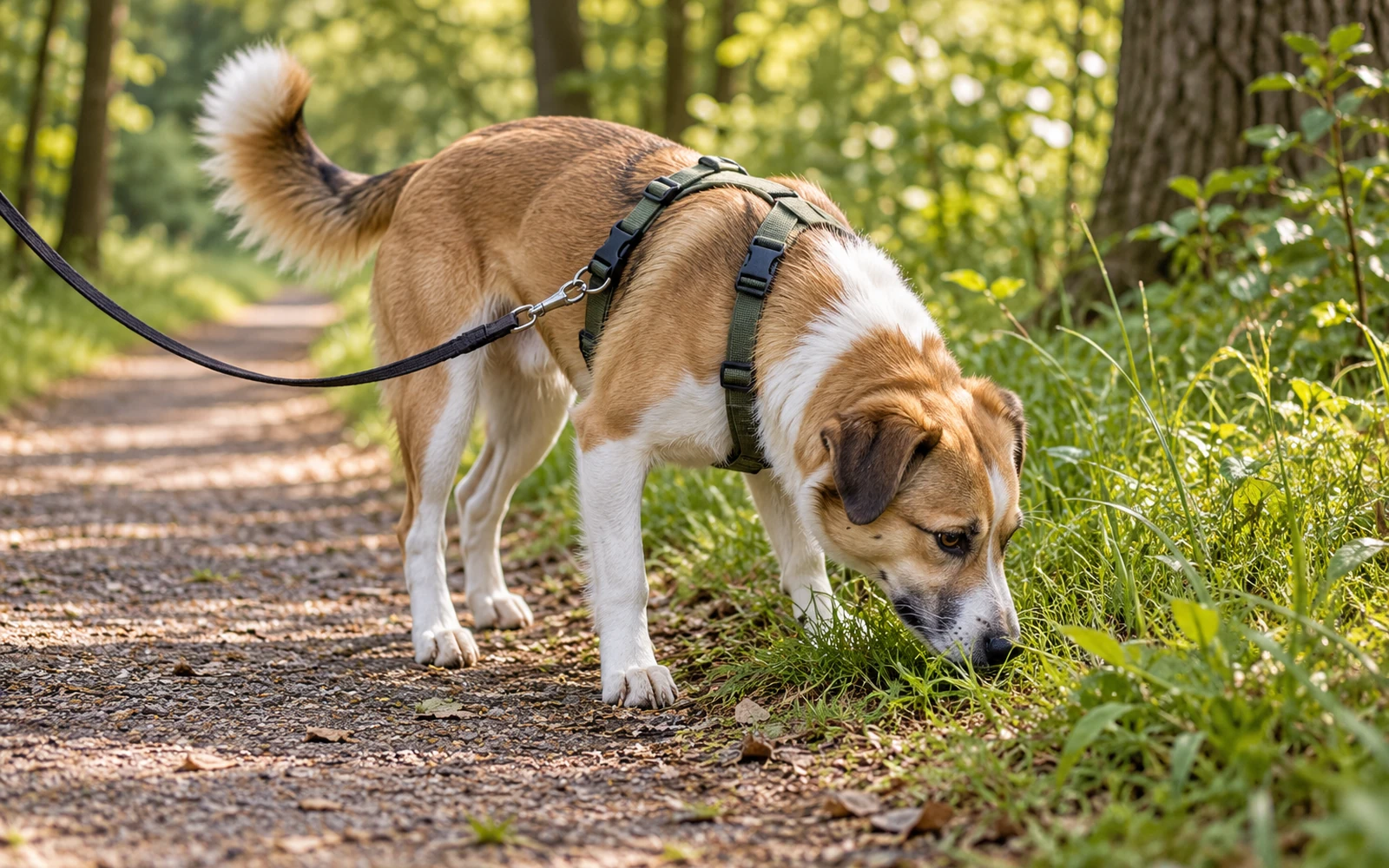
Dogs sniff so much on walks because scent helps them investigate their surroundings, including places other animals have visited. Stopping to explore is normal and can enrich a walk. You can allow sniffing where the path is safe, but guide your dog onward near traffic, hazardous objects or signs of distress. There is no fixed number of sniffing minutes that every dog needs.
Why does your dog sniff the same spot again?
A familiar route does not necessarily smell the same each day. Grass, trees and other surfaces can hold traces left by animals, food and the environment. Some may be new or may have changed since your last walk. Urine marks are one possible source, but not every pause is about another dog or territorial behavior.
From the outside, you cannot tell which particular odor caught your dog's attention or what the dog learned from it. Sniffing alone also cannot establish whether a dog feels calm, excited or uneasy. To interpret a pause, consider movement, posture and the surroundings together. The dog body language guide explains those broader signals.
When should you let your dog sniff?
Offer opportunities to investigate in suitable places rather than requiring the dog to walk continuously or stopping at every odor. Use the conditions around you to decide.
| Situation | What to do |
|---|
| Your dog investigates a clear grassy verge with a loose, comfortable posture. | Allow the pause and maintain manageable leash control. |
| You are near moving traffic, a narrow crossing or a crowded sidewalk. | Keep walking to a safer area before allowing exploration. |
| The dog heads toward dropped food, sharp litter or an unknown substance. | Prevent contact or eating and move away from the hazard. |
| The dog freezes, repeatedly scans the area or becomes noticeably stiff. | Create distance and assess the wider situation instead of assuming the sniffing signals relaxation. |
How to leave a long sniffing stop without pulling
Imagine your dog has stopped at a tree beside a quiet, unobstructed path. Give the dog enough leash slack to investigate comfortably while you maintain control. If the place remains safe, there is no need to interrupt immediately just because progress has slowed.
When you need to continue, use a walking cue your dog already understands and start toward a clear section of the path. Give the dog an opportunity to disengage instead of repeatedly tightening the leash. A separate cue such as “go sniff” can signal when exploration is permitted, but it is optional. If your dog pulls from one smell to the next, work on loose-leash walking as a separate skill; sniffing stops alone will not teach it.
Does science show that sniffing makes dogs happier?
Safe scent exploration lets dogs perform a natural investigative behavior and make choices on a walk led by a person. It is a form of environmental enrichment, but that does not prove every sniffing stop reduces stress or changes mood.
In a small 2019 study of 20 pet dogs, Duranton and Horowitz compared two weeks of structured nosework—searching for a hidden target—with heelwork. After nosework, dogs approached an ambiguous target more quickly in a judgment-bias test, which examines responses when an outcome is uncertain. The researchers interpreted this as a more positive expectation. The experiment did not test ordinary sniffing during walks.
A 2025 scoping review by Fountain and colleagues examined 27 studies involving scent activities in working, shelter and companion dogs. The activities and measurements differed, and the authors found important gaps in evidence about welfare effects. There is no established conversion between minutes spent sniffing and physical exercise, and the review does not show that everyday sniffing walks treat anxiety. Sniffing opportunities can complement, not replace, other activity suited to the individual dog.
When does a change in sniffing need veterinary attention?
Frequent sniffing by itself is not a sign of illness. If an unusual change in walking behavior comes with persistent sneezing or excessive nasal discharge, contact your veterinarian. Difficulty breathing requires urgent veterinary care. Do not assume those signs are caused by an especially interesting scent.