Quick answer
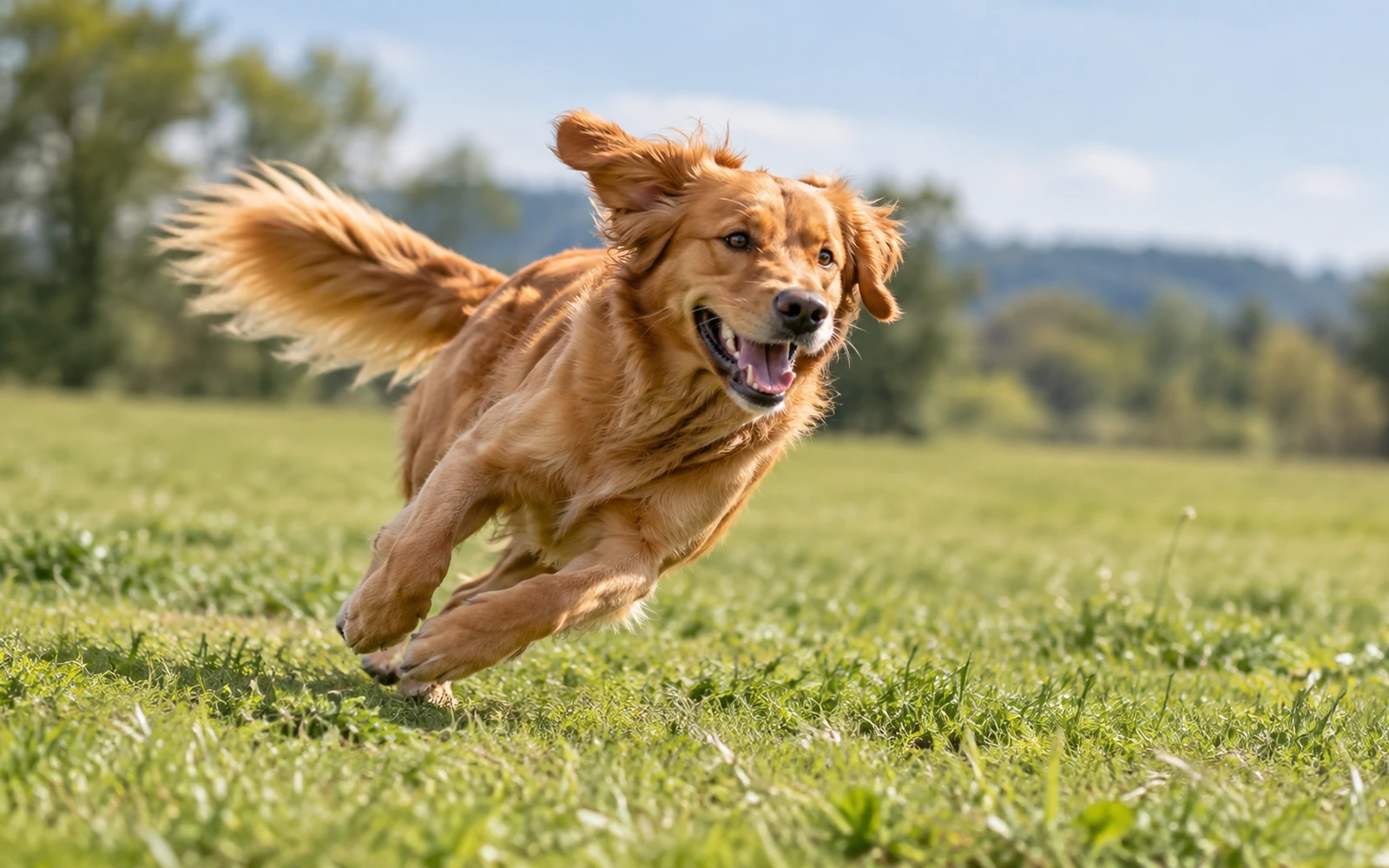
Dog zoomies are brief bursts of fast, energetic movement often called frenetic random activity periods, or FRAPs. They are especially common in puppies and young dogs, but adults can have them too. There is no single proven cause. Zoomies often appear around excitement, play, transitions, evenings, or after events such as defecating or bathing. Most are normal; the useful clues are the dog’s overall body language, the setting, and whether the dog returns comfortably to normal afterward.
What dog zoomies actually are
A typical zoomie starts suddenly. A dog may sprint in loops, make sharp turns, tuck the rear end, bounce, spin, or throw in a play bow before racing off again. The episode is usually short and ends without intervention.
Veterinary behavior resources commonly use the term frenetic random activity periods (FRAPs) for these bursts. They are most common in puppies and young dogs, although some dogs continue to have occasional episodes throughout life.
That pattern matters because zoomies are a description of behavior, not a diagnosis. The same fast movement can occur in different emotional contexts, so the surrounding situation is more informative than the running itself.
Why do dogs get the zoomies?
The most accurate answer is that no single specific cause has been established. Veterinary sources commonly associate FRAPs with excitement, play, pent-up activity, under-stimulation, or the release of tension after a stressful event, but these are observed patterns and plausible explanations rather than one proven biological mechanism.
That distinction is important. Saying a dog zooms after confinement, a bath, play, or a highly exciting event is stronger than claiming the dog is definitely “burning off stored energy” or “releasing stress.” Those interpretations may fit the context, but the behavior itself does not prove which internal process caused it.
Excitement and transitions
Zoomies often show up when arousal changes quickly: an owner comes home, play becomes intense, a dog is released into an open area, or a stimulating activity ends. Cornell’s veterinary guidance also lists play, exciting events and over-stimulation during training among common FRAP contexts.
A practical way to read these episodes is as a visible surge of movement around a high-arousal moment. That description stays close to what can actually be observed without assigning a precise emotion or mechanism from running alone.
After a bath
Post-bath zoomies are common, but there is no single demonstrated reason for them. Bathing combines handling, water, a wet coat, unfamiliar sensations and a transition from relative restraint back to free movement. Veterinary-reviewed sources commonly describe excitement, relief or tension release as plausible explanations.
What the evidence does not justify is treating any one explanation—drying off, restoring scent, relief, stress release or excess energy—as the universal cause. The useful fact is the repeated context: if zoomies reliably start as soon as the bath ends, the bathing process is part of that dog’s pattern.
After pooping
Defecation is another recognized context in which some dogs have FRAPs. The observation is well established enough to appear in veterinary guidance; the mechanism is not.
Claims that post-poop zoomies are caused by a specific nerve response, territorial strategy or burst of “relief hormones” go beyond the evidence used for this article. For an otherwise comfortable dog, a short sprint after defecating can simply be recorded as a predictable FRAP pattern. Straining, pain or a change in bowel habits is a separate issue and should not be explained away as zoomies.
At night
Evening zoomies are especially familiar in puppies. Veterinary sources describe late-evening FRAPs and note that they may be more noticeable after long periods of inactivity or when a young dog has had limited opportunities for physical and mental activity.
One evening episode does not prove a dog is under-exercised. Look at the larger daily pattern instead: age, rest, activity, enrichment, play, training and how easily the dog settles at other times. Frequent late-night episodes that disrupt rest are more useful as a pattern to investigate than a single energetic lap around the room.
Are zoomies a sign of a happy dog?
Often they look playful, but zoomies are not automatic proof of happiness. Cornell describes a typical playful FRAP as loose and wiggly, sometimes with bouncing movement or a play bow. A frightened dog is more likely to look tense, carry the head lower, pin the ears back, show wide eyes, or keep the tail tightly tucked even after slowing down.
The whole-dog picture matters more than one feature. Use the same context-and-posture method described in How to Read Dog Body Language: look at tension, movement, approach or avoidance, facial expression and what happened immediately before the behavior.
A dog can run quickly because it is playful, highly excited, frustrated, frightened or simply transitioning out of another state. The speed does not identify the emotion by itself.
How to keep zoomies safe
The main risk is usually the environment, not the FRAP itself. A dog moving at full speed can slip, collide with furniture, fall on stairs or reach a road before the person can react.
When a dog is likely to zoom:
- keep access to roads and other unsecured areas closed;
- favor enclosed spaces with reliable footing;
- move breakable or sharp obstacles out of a predictable running path;
- keep the dog away from stairs and slick flooring when possible;
- avoid stepping directly into the path of a dog already sprinting at speed.
Grass, packed ground and carpet generally provide more traction than smooth hard floors. If post-bath or evening zoomies happen predictably, preparing the space before the usual trigger is simpler than trying to stop the behavior once the dog is already running.
When zoomies deserve a closer look
Normal FRAPs should still look compatible with the dog’s usual movement and overall state. Cornell advises veterinary help when a zooming dog appears to be in pain, frightened or anxious rather than loose and playful.
A sudden change in the pattern also deserves attention. If a dog that normally has relaxed, brief zoomies begins moving as though uncomfortable, cannot settle afterward, or the episodes repeatedly follow a situation that produces obvious distress, treat that as information rather than assuming the behavior is harmless because it resembles previous zoomies.
For stress-specific patterns outside ordinary play, Signs of Stress in Dogs explains how to evaluate trigger, intensity and recovery. If pain or illness is possible, veterinary assessment takes priority over behavioral interpretation.
A simple pattern check
If zoomies are frequent enough to raise questions, record four things for a week: what happened immediately before the episode, what the dog’s body looked like during it, how long it took to return to baseline, and whether the pattern is becoming more frequent or intense.
That short record usually gives better decision information than trying to label every episode as happiness, stress or “too much energy.” A predictable, loose, brief FRAP in a safe setting can usually be managed as normal behavior. A new pattern associated with distress, pain or poor recovery should be investigated instead of normalized.