What you are teaching
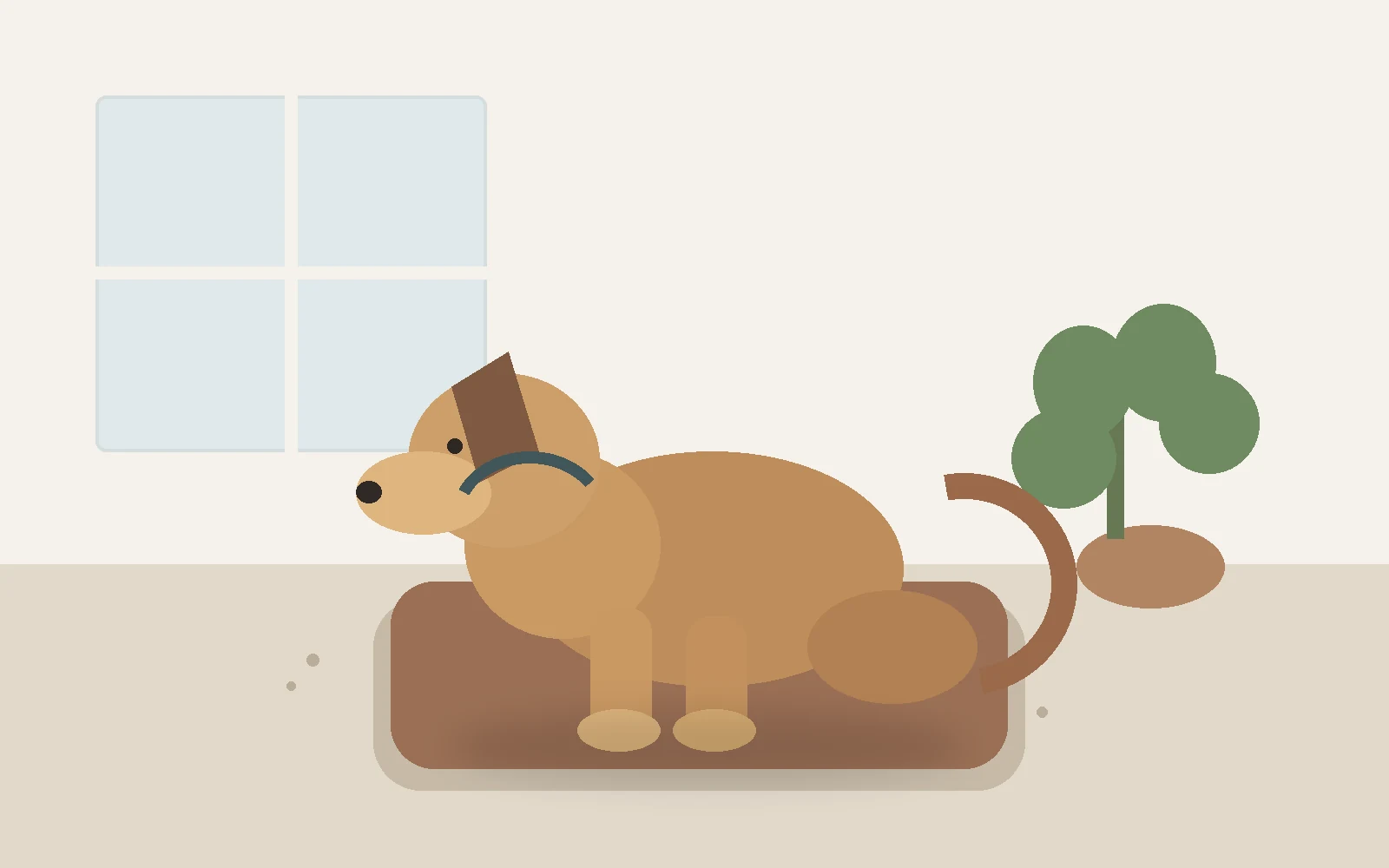
A mat can support two related behaviors:
- Stationing or place: go to a defined surface and remain there until released.
- Settling: become comfortable enough on that surface to reduce interaction, soften posture, and rest while ordinary activity continues nearby.
A dog can hold a technically correct down-stay while staying tense and focused on the handler. For a settle, location matters, but so does the quality of the behavior.
Do not wait for perfect relaxation on the first session. First make the mat easy to understand; once your dog is choosing it reliably, begin reinforcing calmer posture and disengagement.
Before you start
Choose the real-life outcome you want. That might be resting beside your desk, staying comfortably out of the kitchen while you cook, relaxing while visitors sit down, or settling beside your chair in a quiet waiting area. The final use determines how much environmental practice the skill will need.
Use a mat, small bed, towel, or folded blanket that is large enough for your dog to lie on comfortably, stable underfoot, portable, and easy to distinguish from the surrounding floor. Prepare small rewards your dog values.
Begin in a familiar, low-distraction room after your dog has had a chance to toilet, drink, move around, and meet normal social needs. The first session should make the mat an easy choice, not test whether your dog can resist peak excitement.
How to teach a mat settle
Step 1: Reward voluntary interest in the mat
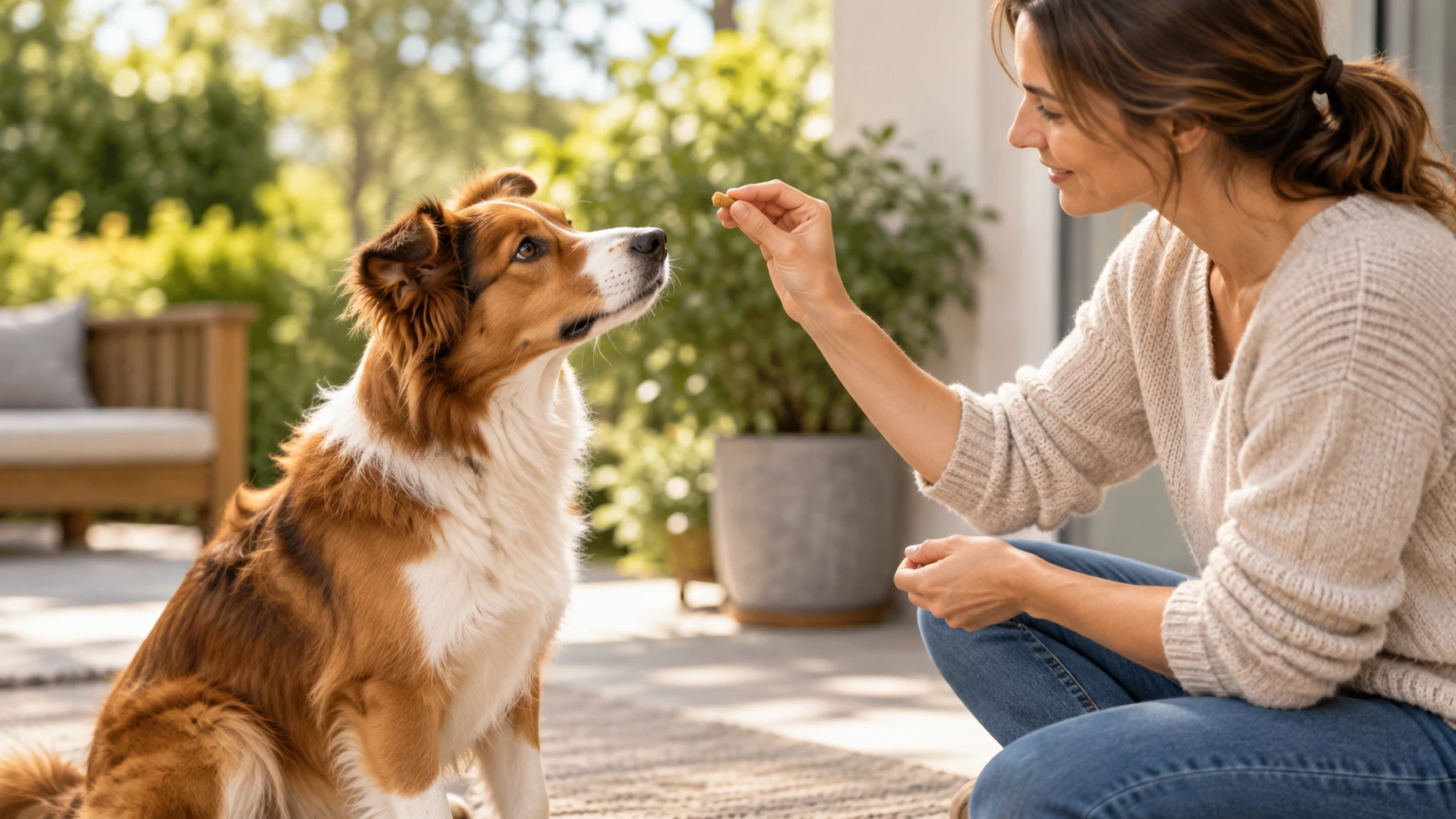
Put the mat on the floor and pause. Mark and reward useful choices such as looking at it, moving toward it, sniffing it, or placing a paw on it. Deliver the reward on or very close to the surface when practical.
Do not place your dog onto the mat or physically hold them there. Some dogs will step on immediately; others may need several repetitions before offering one paw. Start from the behavior your dog is actually giving you.
Once your dog is deliberately returning to the mat, raise the criterion gradually:
- interest in the mat;
- one or more paws on it;
- all four paws on it;
- standing or sitting comfortably;
- lying down.
If your dog already knows a down cue, you can use it after they are comfortable on the surface. Otherwise, wait for a down and reinforce it when it appears. Reward while the dog is still on the mat so the location remains valuable.
Introduce a release cue such as “free” or “all done.” Give the cue, then invite the dog off the mat. The release tells your dog when the current repetition has finished.
Step 3: Reinforce relaxation, not just position
When lying on the mat is easy, start selecting for quality. Useful signs include a hip shifting to one side, the head lowering, softer muscles, less scanning of the room, looking away from you, or longer periods of comfortable stillness.
These are examples, not a rigid checklist. Dogs rest differently. Look for an overall change toward comfort and reduced monitoring rather than demanding one exact posture.
Deliver rewards quietly and low, ideally near the front paws. The aim is a dog who can remain on the mat without needing constant interaction from you.
Step 4: Build duration
Once your dog can settle for a few moments, gradually increase the time between rewards. Mix easier and harder intervals instead of making every repetition longer than the last.
Release while your dog is still succeeding. If the dog repeatedly leaves before the release cue, the current interval is longer than they can comfortably perform in that setup.
Step 5: Add the verbal cue
Add a cue when you can already predict the behavior. If your dog regularly heads to the mat and lies down when it appears, say your chosen cue—such as “settle,” “mat,” “place,” or “bed”—just before the dog performs it.
After consistent pairings, begin giving the cue slightly earlier. If one cue does not produce the behavior, do not repeat it several times; simplify the context and try another easy repetition.
Step 6: Add distance
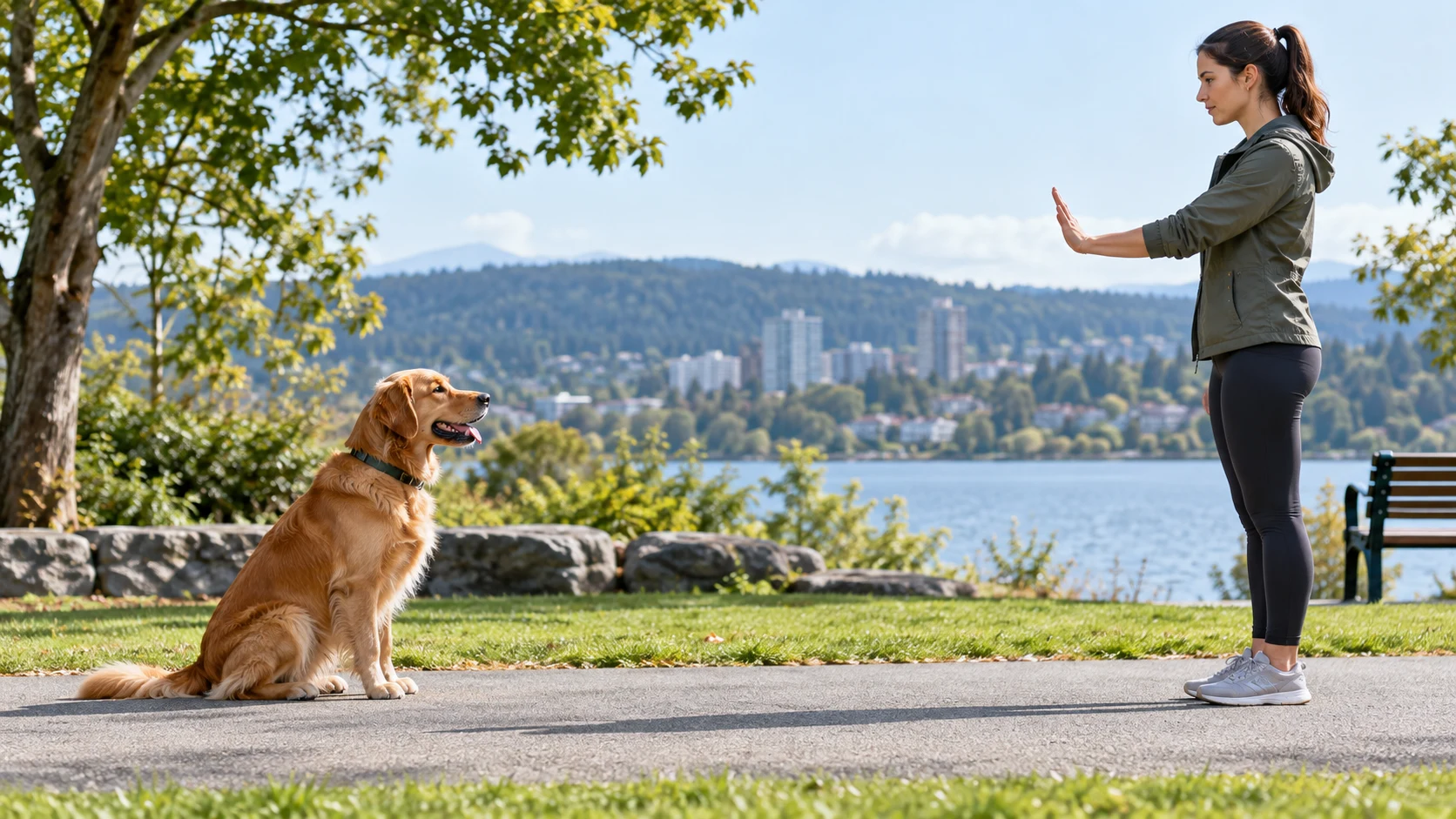
When your dog is comfortable while you are close to the mat, change your position in small increments. You might lean back in your chair, stand and sit down, take one step away and return, walk to a nearby counter, or move around the room briefly.
The goal is for your movement to become background information rather than a signal that the settle has ended.
Step 7: Add distractions
Begin with mild, controllable changes such as picking up a mug, opening a cabinet, another person standing up, or a quiet household sound. Later, practise with the distractions that match your real goal, such as food preparation, seated visitors, or calm activity in a public setting.
Choose distractions your dog can notice without immediately losing the behavior. Harder environments come later.
Use one difficulty dial at a time
Think of the exercise as three main variables:
- Duration: how long your dog is expected to remain settled.
- Distance: how far you move from your dog or the mat.
- Distraction: how much competing activity is happening nearby.
Increase one variable while keeping the other two easy. A dog that can settle for five minutes beside you has not automatically learned to do the same while you walk around or while a guest enters.
How to know when your dog is ready to progress
Move to a harder version when the current one looks routine rather than fragile. Useful signs include:
- your dog goes to the mat without repeated prompting;
- lying down happens readily;
- several easy repetitions succeed in a row;
- reward delivery does not immediately make the dog spring up;
- a small distraction does not derail the whole repetition;
- you can end the repetition with the release cue instead of using it to rescue a behavior that is already falling apart.
If you are unsure, repeat the current level. Progress should follow observable fluency, not a calendar.
Take the skill into real life
Choose one practical use and train toward that context. For desk work, add normal chair movement and keyboard sounds. For visitors, begin with one calm seated person rather than a busy arrival. For outings, start in a quiet, low-traffic location before expecting the skill in a crowded café or waiting room.
A new location is a new training context, not proof that the dog has forgotten the skill. Lower the difficulty enough for the mat behavior to become fluent there before asking for the full version you use at home.
If training stalls, change this first
Use the failed repetition as diagnostic information instead of repeating the same setup unchanged.
| What you see | Likely limiter | What to do next |
|---|
| Your dog gets up after a longer wait | Duration | Return to Step 4: Build duration. |
| Your dog stays settled until you stand or move away | Distance | Return to Step 6: Add distance. |
| A person, sound, food, or another dog breaks the settle | Distraction | Return to Step 7: Add distractions. |
| Your dog watches your hands instead of relaxing | Reward delivery or criteria | Revisit Step 3: Reinforce relaxation, not just position. |
| The behavior works at home but falls apart somewhere new | Context | Rebuild the skill using Take the skill into real life. |
| Your dog paws, bites, or carries the mat | Arousal or setup | Try a heavier, less toy-like surface; if mat play persists, end that repetition rather than turning it into a wrestling game. |
If two variables changed at the same time, simplify both, then rebuild one at a time.
Common mistakes to avoid
Do not reserve the mat only for moments when your dog is already overexcited or in trouble. Early practice should happen when success is easy enough to reinforce.
Keep the mat associated with predictable, worthwhile experiences. Do not use force, intimidation, or physical restraint to make a dog remain there.
Avoid turning every session into an endurance test. Short successful practice teaches the skill more clearly than repeatedly waiting for the dog to fail.
When to stop or reduce the difficulty
An ordinary mistake does not require ending the session, but a pattern of deterioration does. Reduce the challenge or stop for now if you see escalating vocalization or frantic movement, persistent attempts to escape the setup, inability to take or calmly eat rewards, growing fixation on a trigger, or increasingly intense interaction with the mat instead of settling.
The purpose of the session is to make the desired behavior understandable and achievable. If the dog is no longer able to participate calmly, more repetition at the same level is not productive.
How long should a dog settle on a mat?
There is no universal target duration. Build toward the amount of calm time that serves your real situation. One household may need a few minutes while food is prepared; another may want a longer rest period during desk work.
Duration should follow function. The practical goal is comfort for the period you actually need, not beating an arbitrary time record.
Mat training is an everyday skill, not a complete treatment plan for serious behavior concerns. If your dog shows intense fear, aggression, panic around separation, or persistent distress that prevents normal settling, the priority is a broader assessment rather than making the mat exercise stricter.
Likewise, if a dog that normally settles comfortably suddenly cannot get comfortable, consider what may be happening outside the training exercise rather than assuming the dog simply needs more practice.